



SPORTS
Snowboarding is a winter sport where balance, speed, and creativity meet as athletes ride down a snow-covered slope on a single wide board with both feet secured by bindings. Riders control their speed and direction by shifting their weight to carve through turns, transforming a downhill run into a full athletic art form built on style and speed.
Long before snowboards were sold at stores, innovators were already strapping wooden planks to their feet in search of a new way to ride the snow. The breakthrough came on Christmas Day, 1965, when Sherman Poppen bound two skis together to build a single board for his daughters.
Sherman’s wife, Nancy Poppen, blended “snow” and “surfer” to name the invention the “Snurfer”. The Snurfer became a commercial sensation, selling more than a million units over the following decade and planting the seed for one of the Winter Olympics’ most thrilling sports.
Shaun White won Olympic gold at every Winter Games he competed in.
Shaun White is a three-time gold medalist (Turin 2006, Vancouver 2010, PyeongChang 2018), but he finished fourth at Sochi 2014.
What snowboard trick sequence clinched Chloe Kim her first Olympic gold medal?
Kim performed this trick sequence in her final run at PyeongChang 2018 at just 17 years old.
Which Team USA Paralympian helped bring Para Snowboard to the Paralympic Games in the first place?
Three-time Paralympic medalist Amy Purdy, who co-founded Adaptive Action Sports with Daniel Gale in 2005, campaigned to include Para Snowboard in the Paralympic Games.
You got 0 out of 3 correct!
Sign up for our Monthly Newsletter to learn more about Olympic & Paralympic sports
Snowboarding officially debuted as a Winter Olympic sport at the 1998 Nagano Games, featuring four events: men’s and women’s halfpipe and giant slalom. As snowboarding gained popularity and acceptance, the Olympic program expanded beyond its original two disciplines, halfpipe and giant slalom, into a full program that now includes snowboard cross, slopestyle, and big air.
From high-flying stunts to side-by-side racing, the five snowboarding disciplines in the Winter Olympic Games showcase the sport’s versatility across a total of 11 gold medal events. These events are split between freestyle competitions and timed speed racing.
Competitors ride back and forth down a semi-cylindrical “U-shaped” ditch with vertical ice walls used to perform consecutive flips, spins, and grabs.
Competitors link their tricks together as they navigate a downhill course packed with obstacles, including rails, giant jumps, boxes, and wall rides, where judges score the run as a whole.
Competitors launch off a single, massive ramp for three runs, performing a different trick each time. Their two highest-scoring runs are combined for a final score.
Four competitors race simultaneously down a narrow course filled with sharp banks, rollers, jumps, and drops. It features individual men’s and women’s events, and is the only snowboard discipline to include a Mixed Team Event, the snowboard cross relay.
Two snowboarders race side by side down identical parallel courses with a series of gates that test the riders’ technical carving and speed as they make their way to the bottom.
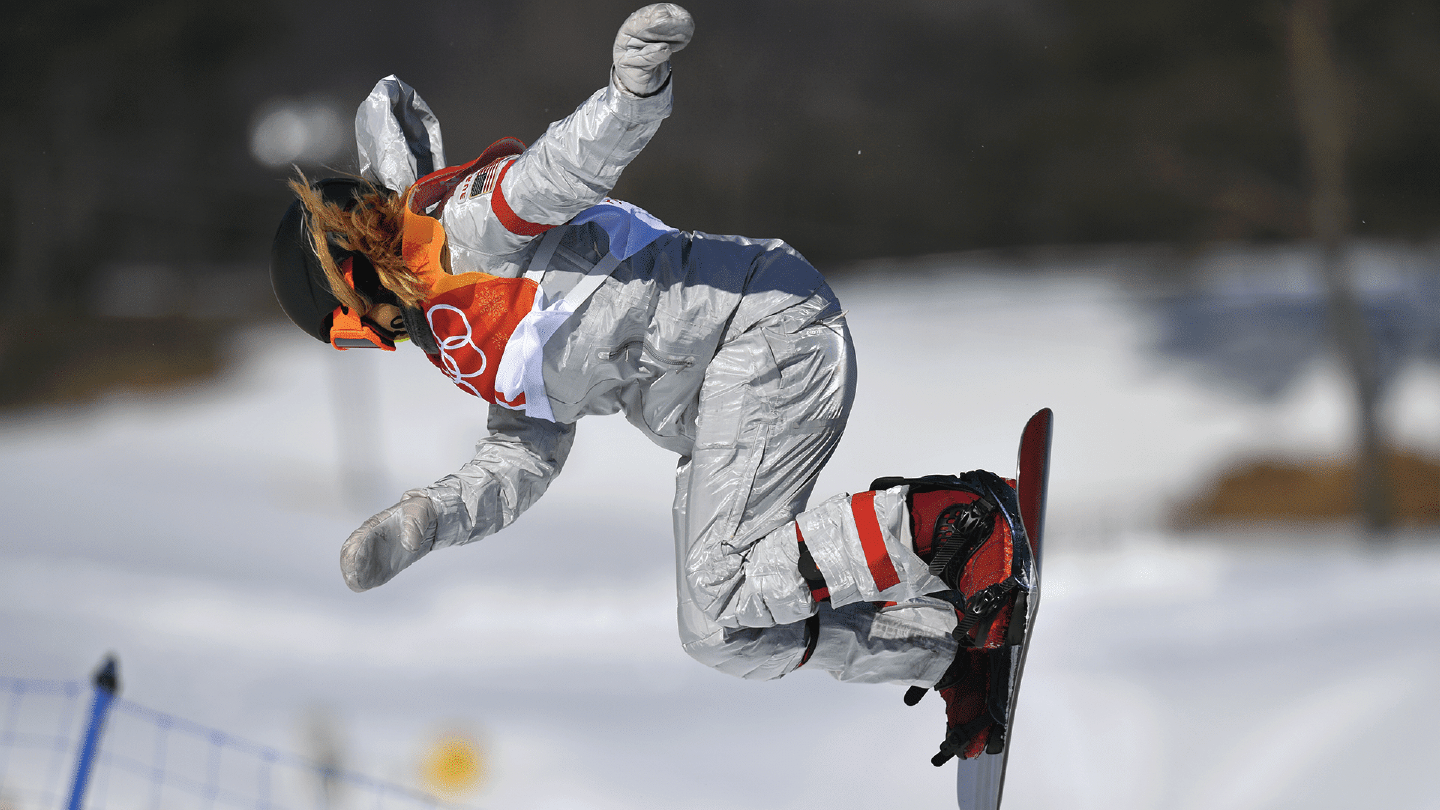
Since the sport’s debut at the Nagano 1998 Winter Olympic Games, Team USA has led the Olympic snowboarding medal table with record-setting performances and historic victories.
Ross Powers, Danny Kass, and J.J. Thomas swept the men’s halfpipe podium at the Salt Lake City 2002 Winter Olympic Games, Team USA’s first sweep at a Winter Games since 1956. Snowboard legend Shaun White added to his legacy with a third Olympic gold, and Chloe Kim stunned the world with back-to-back 1080s to win her first gold medal at just 17 at the PyeongChang 2018 Winter Olympic Games.
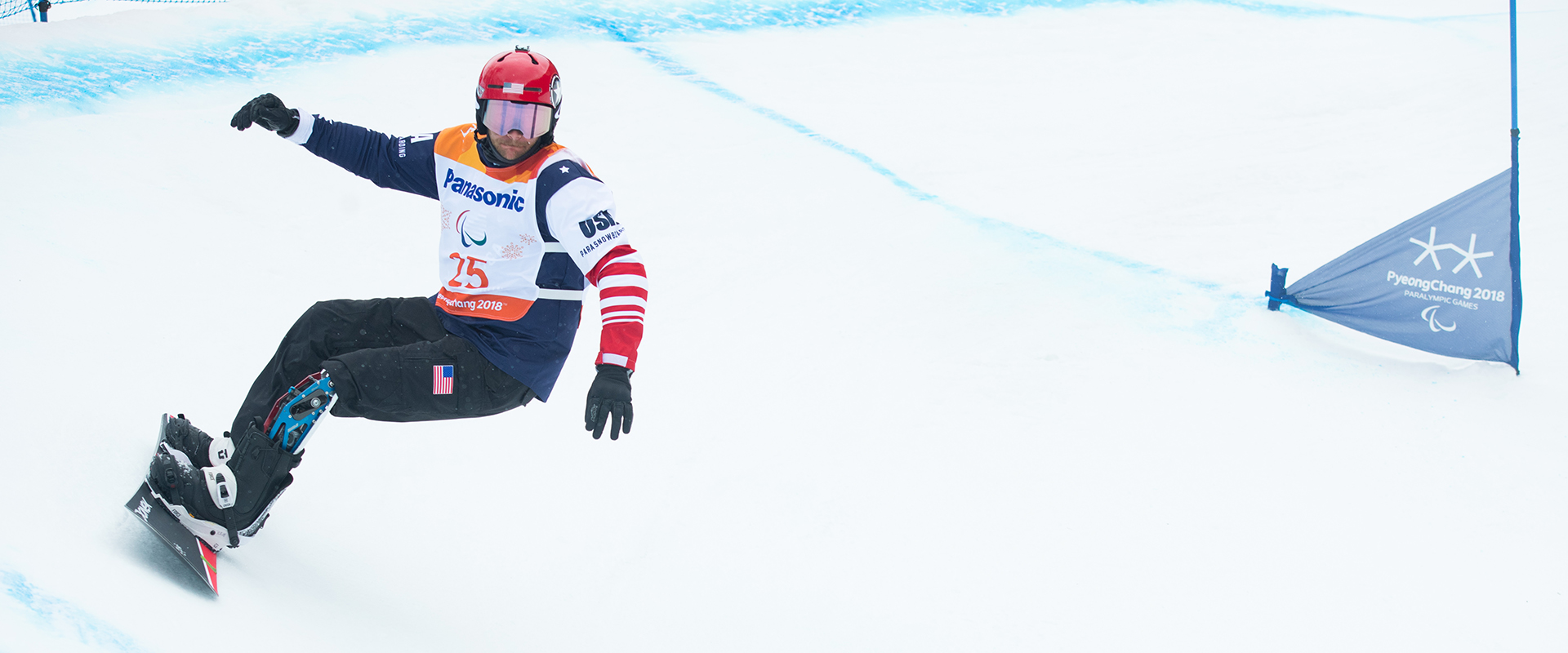
Para snowboard, also called adaptive snowboarding, is a modified version of snowboarding for athletes with physical impairments who ride using specialized equipment. While Olympic snowboarding includes artistic freestyle events, Para snowboard is strictly a timed racing sport focused entirely on speed.
Para snowboarding gained global traction when a group of pioneer athletes campaigned to add the sport to the Paralympic Winter Games. Leading that effort were three-time Paralympic medalist Amy Purdy and her partner, Daniel Gale, who in 2005 co-founded Adaptive Action Sports (AAS). They dedicated their non-profit to helping people with permanent physical disabilities get involved in skateboarding and snowboarding.
Purdy and Gale’s campaign paved the way for the sport’s long-awaited Paralympic debut less than a decade later, when para snowboard was made an official sport at the Sochi 2014 Winter Paralympic Games, becoming one of the fastest-growing sports in the Paralympic Winter Games.
Today, the sport features the top male and female athletes competing in standing classifications using adaptive equipment. Depending on their functional ability and the nature of their impairment, athletes are placed in one of three sport classes that determine how they compete.
There are two dynamic disciplines featured at the Winter Paralympic Games, the banked slalom and snowboard cross.
Competitors are timed as they race down a course filled with banked turns as fast as possible. The fastest single run determines the final ranking.
Competitors first participate in timed speed runs, then race head-to-head in heats of four, navigating a uniquely designed course filled with jumps, rollers, and tight turns.
Team USA’s para snowboard legacy has remained one of the strongest in the sport’s history, even as international competition has intensified. In the sport’s inaugural Paralympic appearance at the Sochi 2014 Winter Paralympic Games, Team USA dominated the podium (Gold, Silver, Bronze) in the men’s snowboard cross.
Since then, athletes like Brenna Huckaby, Mike Schultz, and Kate Delson have kept Team USA on the podium at every Winter Paralympics that has followed, solidifying America’s position as a top competitor in the sport.
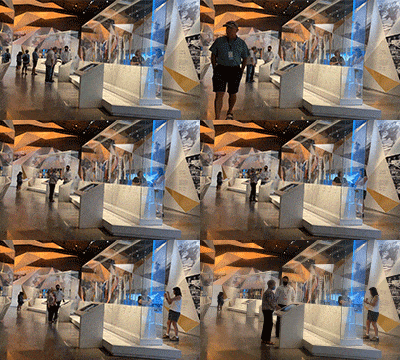
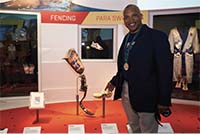
Honor the historic achievements of U.S. snowboarders and para snowboarders at the U.S. Olympic & Paralympic Museum, Olympic City’s top sports attraction. Explore new displays at the Winter Games exhibit, engage virtually with U.S. Olympic & Paralympic Hall of Fame athletes, or tour immersive galleries that showcase Team USA athletes and their incredible journeys. Plan your visit to the U.S. Olympic & Paralympic Museum in Colorado Springs for an unforgettable experience the whole family will love.
Olympic Snowboarding includes both judged freestyle events and timed racing. Para Snowboard is exclusively a timed racing sport for athletes with physical impairments, contested in Banked Slalom and Snowboard Cross using adaptive equipment.
Para Snowboard became a Paralympic sport at the Sochi 2014 Winter Paralympics as part of the Para Alpine Skiing program before becoming its own distinct sport at the PyeongChang 2018 Winter Paralympics.
Olympic snowboarding freestyle events like Halfpipe, Slopestyle, and Big Air are scored by a panel of judges on execution, amplitude, and progression. Olympic snowboarding racing events like Snowboard Cross and Parallel Giant Slalom are decided by the clock or by crossing the finish line first.
Team USA’s most notable Olympic Snowboarders are Shaun White, a three-time Olympic halfpipe gold medalist (Turin 2006, Vancouver 2010, PyeongChang 2018), and Chloe Kim, a two-time gold medalist who won her first title at age 17 in PyeongChang 2018 with back-to-back 1080s.
Team USA has led the Olympic snowboarding medal table since the sport’s 1998 debut, highlighted by the 2002 Salt Lake City halfpipe podium sweep, the country’s first medal sweep at a Winter Olympics since 1956.